The short answer
Google says a business can report a review when it appears to violate Google policies, and Google decides whether the review is removed. Google Business Profile Help.
A review is not a policy violation just because it is negative, unfair, short, angry, or damaging to bookings. That is the hard part for owners: the emotional urgency is real, but the public response still needs to be calm and evidence-led.
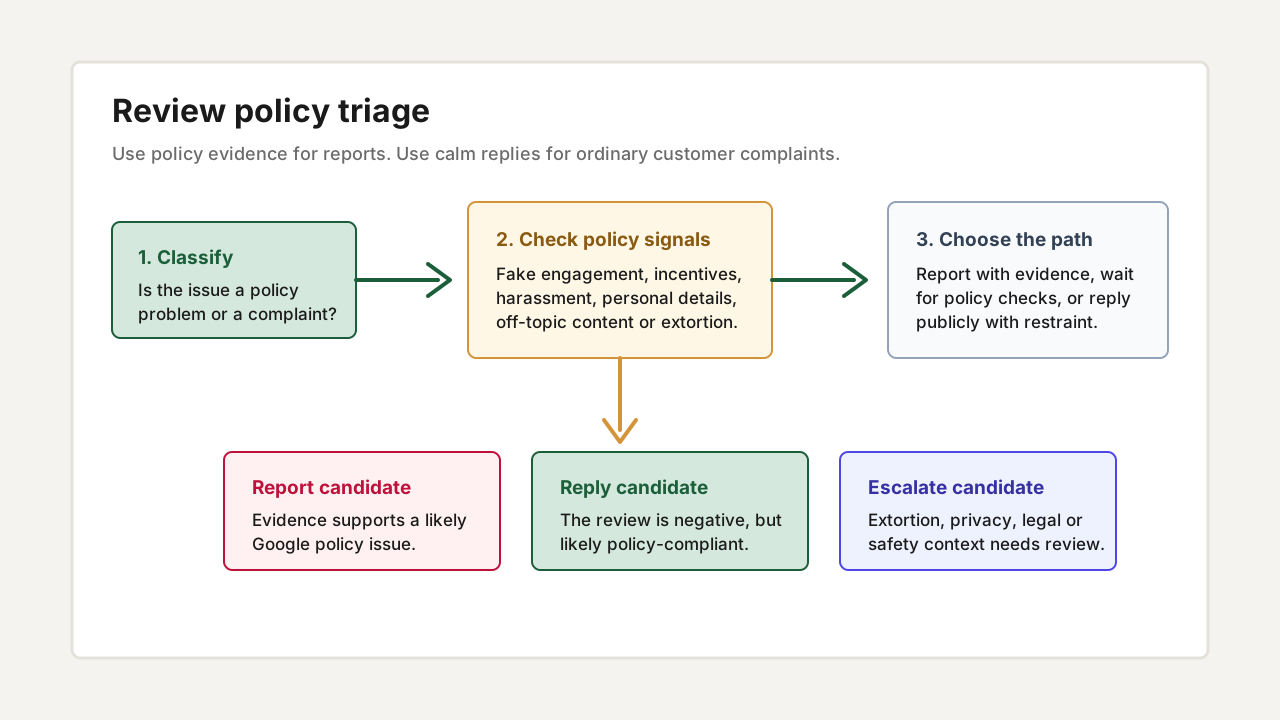
The practical workflow is simple. First, classify the review. Second, collect only the evidence that supports the classification. Third, choose one of three paths: report it to Google, escalate a serious situation such as extortion, or write a restrained public reply that protects trust while you handle the customer privately.
What usually counts as a policy issue
Google Maps policy says prohibited review content includes fake engagement, misrepresentation, impersonation, misinformation, harassment, hate speech, offensive content and restricted personal information. Google Maps User Generated Content Policy.
For a business owner, those categories translate into a few everyday checks. Did the reviewer describe a real experience with the correct business? Is the review from an employee, competitor, paid reviewer, or someone being rewarded? Does it reveal private information, threaten the business, target a person, or discuss something unrelated to the service?
Those questions are more useful than asking whether the review is "bad." A genuine customer can leave a harsh one-star review that still stays inside policy. A polite five-star review can be a problem if it was bought, incentivized, or posted by someone with a conflict of interest.
Use evidence before you report
The strongest report packet is narrow. Match the review to one likely policy issue and keep the evidence close to that issue. For example, a booking system screenshot may help show that a reviewer was never a customer. A screenshot of a message demanding payment to remove a review belongs in an extortion packet. A note from the manager that simply says "this is unfair" is not enough.
Google provides a dedicated reporting path for negative review extortion scams, including cases where someone threatens bad reviews or asks for compensation to remove them. Google Business Profile Help.
If the situation is legal, safety-related, privacy-sensitive, or involves a named staff member, slow down. The public reply should not disclose private customer details, diagnose the customer's motives, or argue every fact in the review thread. Handle evidence inside the reporting flow or private support channel instead.
When a reply is the better move
If the review describes an ordinary complaint, report-first is usually the wrong reflex. A professional reply can do more for future customers than a doomed report. It shows that the business is present, accountable, and not trying to erase every uncomfortable review.
Use a reply when the review is based on a real transaction, when the customer is upset about price, timing, communication, staff manner, cleanliness, quality, or a missed expectation, and when there is no strong policy evidence. The reply does not need to win the dispute. It needs to show that the business takes feedback seriously.
A safe pattern is: acknowledge the concern, avoid private details, invite direct follow-up, and keep it short. For example: "Thanks for raising this. I am sorry the experience did not match what you expected. Please contact us directly so we can review the details and respond properly."
Review requests and incentives need their own guardrail
Google tells businesses not to offer incentives to customers in exchange for reviews, and review requests should not be limited only to customers who had a positive experience. Google Business Profile Help.
This matters because policy risk is not only about incoming negative reviews. Businesses can create their own risk by asking only happy customers, offering discounts for reviews, or steering unhappy customers away from Google. A reply workflow should sit beside a clean review-request workflow, not compensate for a risky one.
For multi-location businesses and agencies, write the rule down. Do not reward reviews. Do not ask staff to review their own location. Do not ask customers to change a review in exchange for a benefit. Do ask every customer in a consistent way and keep replies professional when the answer is not flattering.
Do not confuse delay with deletion
Google says reviews can be delayed or removed while automated systems and human operators check for policy violations. Google Business Profile Help.
That means a missing review is not always a manual penalty, and a delayed review is not always evidence that the customer deleted it. If an owner asks why a review disappeared, separate the possibilities: policy filtering, profile or category restrictions, reviewer action, or a normal processing delay.
The same boundary applies to SEO and AI-search work. A sitemap, crawler access, schema, or clear policy article can help discovery and interpretation, but it does not prove indexing, ranking, traffic, or AI citation. Those outcomes need their own first-party evidence.
How AI search guidance changes the proof boundary
Google's current AI-search guidance keeps the focus on ordinary Search fundamentals: useful content, crawlable pages, clear structure, accurate snippets, and no special "AI-only" markup requirement for inclusion in AI features. That supports a useful policy guide, not a visibility promise.
Bing and Perplexity publish discovery guidance for AI-search surfaces, but crawler access is still only an access signal. It is not proof that a page is cited, trusted, indexed, ranked, or shown to users. For Bing and Copilot specifically, Bing Webmaster Tools AI Performance reporting is the stronger evidence layer when it is available.
For this article, the GEO goal is modest: make the policy triage easy to quote, easy to verify from primary sources, and clearly separated from sales claims. The proof of AI visibility comes later from platform-owned or directly observed citation evidence, not from publication.
Where Local Review Reply fits
Local Review Reply should not be the judge of whether Google removes a review. The product is useful before and after that decision. It can flag low-star reviews for owner attention, help structure evidence notes, keep sensitive replies in approval, and draft a fallback response when the review remains public.
Use the Google review removal eligibility checker when you need a quick policy-readiness check. Use negative Google review reply examples or 1-star reply guidance when the review is probably not reportable. Use the approval workflow when several people need to review replies before anything appears on Google.
The business outcome is not deleting every bad review. It is making sure each review gets the right treatment: report policy problems with evidence, escalate serious situations carefully, and reply professionally when the complaint is legitimate or uncertain.